On a laminated glass cutting line, the heater can’t be the bottleneck. If it can’t keep up, the operator is stuck between slowing the line to avoid cracks or running full speed and betting against optical distortion and delamination. Either way, scrap climbs, rework stacks up, and the schedule slips. The cutting heater isn’t just a warm-up step. It’s the thermal gatekeeper for edge quality, dimensional stability, and throughput. An uneven thermal field creates hot spots and steep gradients, and that thermal stress fractures plies during cutting or leaves you with wavy glass that fails optical inspection. Uniform heating prevents those failures. It keeps the entire sheet inside a repeatable thermal window, so the cutting head meets predictable material behavior—not a patchwork of hot and cold zones.
What Matters Technically
We build laminated glass cutting heaters around one goal: stable, repeatable temperature across the active area, with fast recovery after opening the hood and minimal drift over long runs.
- **Even thermal field, measured where it matters.**The heating zone is engineered so temperature spread stays tight across the glass surface. In practice, that gives consistent softening at the cut line and reduces micro-cracks and chipping. We validate uniformity with mapped sensors under glass, not in free air, because air patterns and emissivity can throw you off.
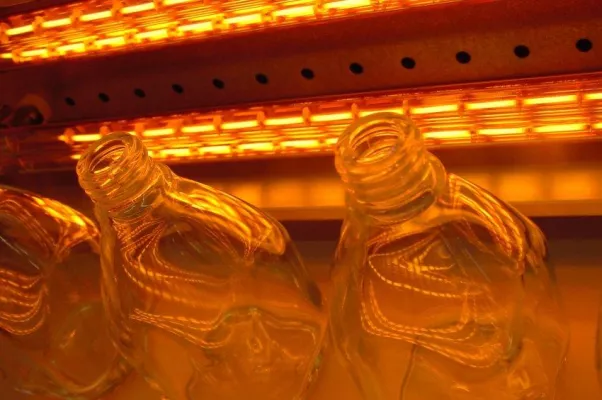
- **Infrared energy matched to how glass responds.**Quartz infrared elements deliver rapid, direct energy into the glass stack. The wavelength is chosen to penetrate the interlayer without overheating the outer plies first, which helps prevent local expansion mismatch and optical distortion.
- **Control that follows the process, not the other way around.**Closed-loop temperature control with high-resolution sensing holds setpoint despite line voltage swings and ambient changes. You get fast stabilization after startup and minimal overshoot when the heater cycles, so every sheet has a consistent thermal history.
- **Power sized for real glass stacks.**Laminated assemblies are thicker and more variable than monolithic glass. We size heaters to bring multi-ply stacks to cutting temperature within the cycle time, without pushing the interlayer into degradation. The typical setup supports rapid heat-up and stable holding so the line can run at planned speed.
- **Industrial build, planned for maintenance.**Elements and reflectors are arranged for even coverage, with access points that let you swap components quickly. Downtime is measured in minutes, not hours.
Why It Works on the Floor
On a laminated glass cutting line, the heater touches three realities: safety, optical quality, and uptime. **Safety shows up as scrap rate.**Uneven heating creates thermal stress that shows up as edge cracks and spontaneous fracture after cutting. When the thermal field is uniform, stress concentrations drop. You get fewer rejects from breakage and fewer safety issues tied to unstable glass handling. **Optical performance starts before the cut.**Wave, roller wave, and local distortion often trace back to uneven heating and poor temperature control. Uniform heating preserves flatness and minimizes optical aberrations, especially on coated or tinted plies that are more sensitive to thermal gradients. The payoff is higher first-pass yield in optical inspection. **Throughput depends on recovery, not peak heat.**The line needs the heater to come back to temperature quickly after each cycle. If recovery is slow, operators slow the line to compensate. A properly matched heater recovers fast, keeps the thermal window stable, and lets the line run at design speed. That means more cuts per hour and predictable output. **Energy use is a process variable, not a guess.**Direct, controlled infrared heating is efficient because energy goes where it’s needed—into the glass stack—without heating large air volumes. That lowers kWh per cycle and reduces peak demand. You get repeatable results without paying for waste heat. **Reliability is a production constraint.**In a plant, a heater failure stops the line. We engineer for long element life and robust thermal mechanics, and we back it up with a straightforward replacement plan. Fewer failures mean fewer unplanned stops.
The Details That Keep It Honest
Uniform heating only works when the whole system delivers it. Here are the practical details that matter on the factory floor.
- **Glass stack variability changes the thermal load.**Thickness, ply count, interlayer type, and coatings all shift the heating requirement. We set up the heater and control parameters to cover a defined range. If your mix moves outside that window, the heater may need retuning. Give us your typical stack profile up front so the setup matches reality.
- **Installation alignment affects uniformity.**The heater has to sit parallel to the glass plane, with proper clearance and consistent airflow. Misalignment creates shadowing and uneven temperature. We supply alignment fixtures and clear tolerances. Set it right once, or you’ll fight drift forever.
- **Control tuning is part of commissioning.**PID settings that work on one line don’t always transfer perfectly to another due to line speed, conveyor thermal mass, and air movement. We commission the control loops on your line, on your glass, at your speed. After that, keep the same tuning discipline—don’t chase temperature by turning up the setpoint.
- **Clean power supports stable heating.**Voltage sags and spikes push the heater into over- and under-shoot. If your facility has significant voltage swings, plan for power conditioning. It keeps the thermal window tight and reduces stress on the elements.
- **Heater output degrades over time.**Even with good care, elements lose output as they age. Plan preventive replacement based on hours and what you see in recovery time. A small scheduled stop beats an unexpected line halt at peak production. If your laminated glass cutting line is battling cracks, distortion, and inconsistent cycle times, slowing down isn’t the answer. Make the heat consistent, and the rest starts to behave. That’s how you protect the glass, protect the operator, and protect the schedule.